
By Jocelyn Hendricks, M+W Staff Writer
STEM–or Science, Technology, Engineering, and Math–is one of the most popular fields of work, with a projected growth of 7.8% in 2026. Even though these numbers are high, Black Americans in the STEM field are not widely recognized.
Although comprising roughly 9% of the STEM workforce, their contributions have been minimized throughout history. The Eastman Oratory contest shines a light on their work, enlightening students and our community during Black History Month.
Students across East Tennessee participate in the contest, writing about Black Americans who have made major STEM contributions. The students also get a chance to earn prizes up to $1,500.

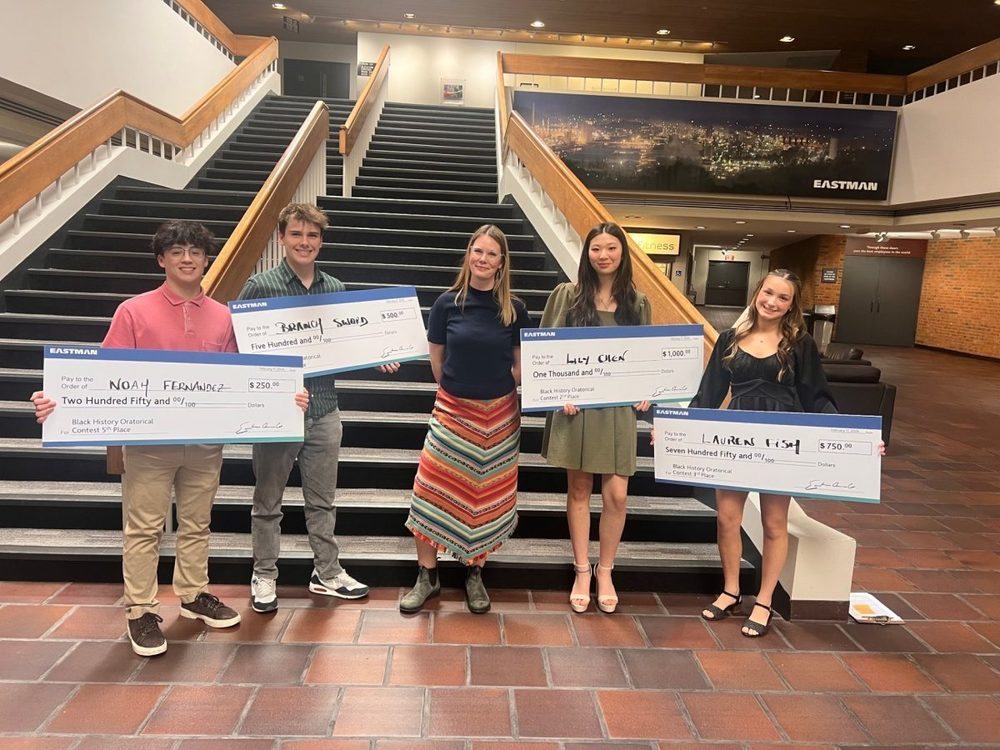
This year, Tennessee High is proud to feature four of the top five winners: Lily Chen, Lauren Fish, Branch Sword, and Noah Fernandez.
“I’m incredibly proud of these students, and all those who have invested in this research,” said advising teacher, Mariel Story. “In the past 5 years, Tennessee High students have won first place three times, and for the last two years, we’ve had four out of the top five speeches.”
Eastman invited the winners to the Toy F. Reid Center in Kingsport on Tues., Feb. 17, to introduce their essays in a judged format for critique before an audience. The writers had to produce high-quality written work and deliver their articles publicly.
The contest gives students not only the opportunity to practice writing skills but also to work on their public speaking and research skills while aiming to win cash prizes.
Although the process was challenging, students said Story helped them prepare very well.
Junior Lauren Fish, who won third place for her speech on Kizzmekia Corbett, a key developer of the Covid- 19 vaccine, said, “[Mrs. Story] helped us a lot by teaching us how to find background information, using citations, etc.”
Students who participated in this contest all stated that Story helped lead them through the process and made sure their essays stood out from the rest.
“She kind of just led us through the process of everything,” Fish said.
In some cases, research could be hard to complete because there was not sufficient documentation at the time certain discoveries were being made, or the topic was not highly publicized.

“Info about Emmett Chappelle was very limited, but luckily, the more I was able to hunt, the more I could actually find some good information,” said junior Branch Sword, who won fourth place for his speech on the “father of bioluminescence.” “I was also very surprised that something as cool as his invention was not as heavily publicized as it should be.”
Though students struggled with the lack of information, they noted that the real problem rests in how many Black Americans in STEM aren’t adequately recognized. The oratory contest gives both the audience and the writer the chance to learn about these contributions, especially those who are not remembered.
“I wrote about Dr. Marilyn Hughes Gaston because there wasn’t much about her, and her story was untold, so I wanted to give her a voice,” said junior Noah Fernandez, who won fifth place.
He found inspiration through Gaston’s 1986 “groundbreaking study” that proved that “giving infants with Sickle Cell Disease long-term penicillin treatments could prevent the deadly infections.”
Students such as Fernandez agree that this research gives them a chance to appreciate Black Americans in STEM more, and influences their views of Black History Month.
Junior Lily Chen, who won second place for her research on Flemmie Kittrell, “the secret woman behind Head Start,” lamented the fact that important figures have been buried in history.
“I didn’t even know about [Kittrell], and she wasn’t credited a lot, but her contributions and experiments contributed a lot to [Head Start],” Chen said. This is why, ultimately, Chen viewed her speech as a “way to say thank you.”
Visit thsmaroonandwhite.org for more stories about THS!